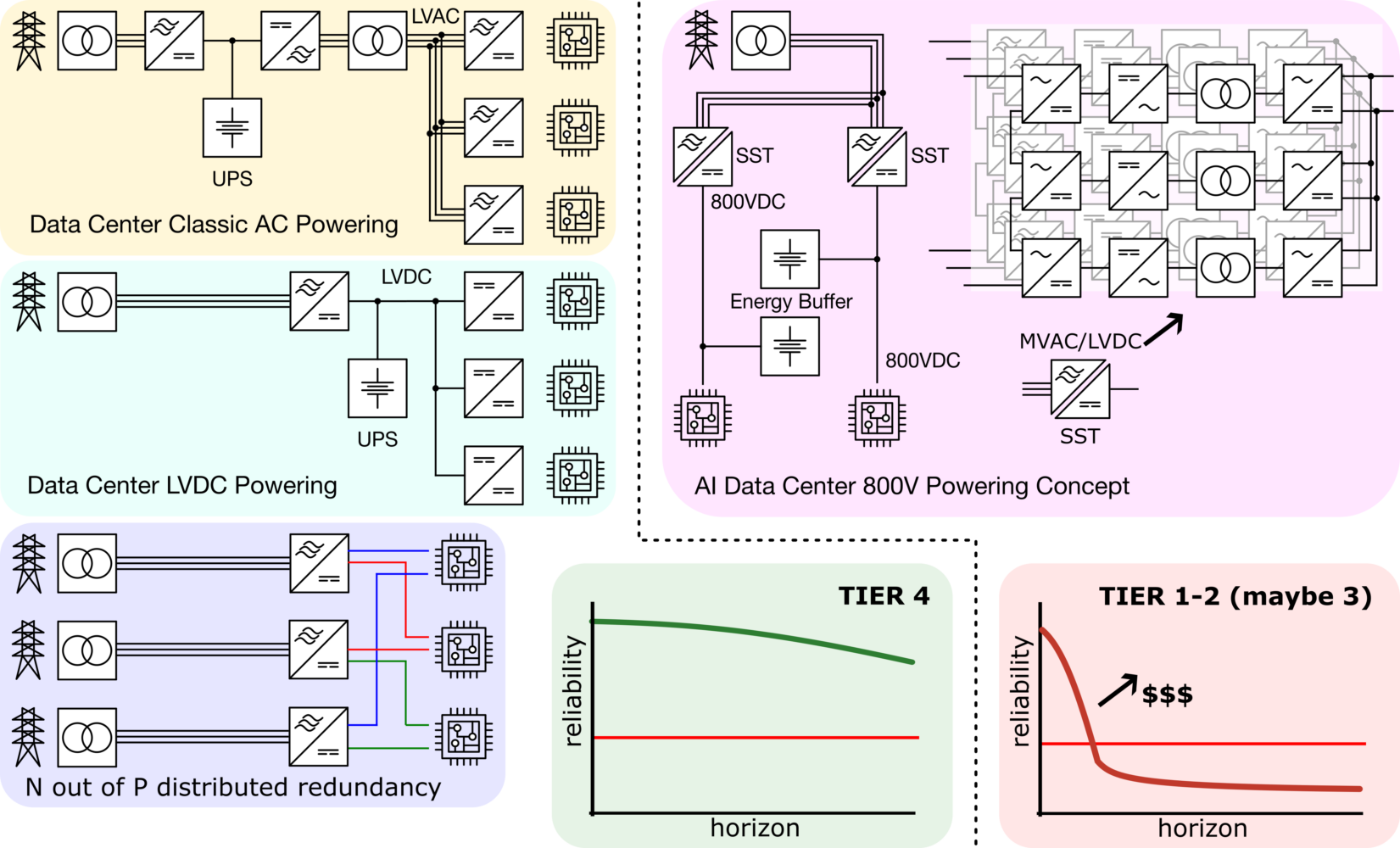
Data centers live and die by one number: uptime. Before discussing megawatts, efficiencies, or power architectures, one must understand what the industry actually demands from its power infrastructure. The Uptime Institute’s Tier Classification System has become the de facto benchmark, ranging from Tier 1, which tolerates up to 28 hours of downtime per year, to Tier 4, which permits a mere 26 minutes of downtime annually. Tier 4, corresponding to an availability of 99.995%, is typically the realm of military installations and extremely sensitive data operations.
Reaching such numbers is not a matter of building better converters. It is a matter of architecture: redundancy everywhere, including the utility grid itself, all of this combined with maintenance management, made of spare parts and repair logistics, because availability targets are directly tied to the Mean Time To Repair (MTTR). Data center downtime is measured in cost per minute, and availability commitments are contractual. Any candidate power architecture must demonstrably survive component failures without interrupting the IT loads.
In this article, I want to share some reflections triggered by a reliability study I recently worked on, and raise what I believe is an important question for the ongoing buzz related to the electrification of AI-scale data farms.
The classical approach
The classic AC powering chain of a data center is almost boring in its simplicity. Medium-voltage AC arrives from the utility, a conventional transformer steps it down to LVAC, and a UPS sits in series, bridging grid outages with its battery string. Downstream, another conversion stage feeds the 48 V DC buses of the IT racks. The UPS performs a double conversion and the batteries hang on the intermediate DC bus through yet another DC-DC stage. From a pure efficiency standpoint, it is arguably wasteful.
And yet it works, with high reliably. Combined with a K-out-of-N redundancy scheme, where each server receives power through multiple independent paths, classical AC powering reaches Tier 4 today. The power path redundancy means that a failure in one line simply reroutes the power; the failed branch is repaired while the system keeps running.
LVDC for better efficiency
Let’s consider the following architecture: MVAC to LVAC transformer, a diode rectifier for creating an LVDC bus (say between 400 and 800V), and the UPS operating in parallel. By removing conversion stages, the efficiency naturally improves, replaces bulky AC distribution chains. Besides, servers natively consume DC, so feeding them from an LVDC bus removes an entire AC-DC stage at rack level.
The gain is measurable. Fewer conversion stages mean fewer losses, less cooling, smaller footprint. Moreover, with adequate redundancy of the DC converters, the reliability argument seems to hold: replicate the converters, and the probability of losing all power paths becomes vanishingly small.
So far, so good…
The Solid-State Transformation promises
Here is the aspect that, in my view, is not discussed enough: the moment you bring solid-state converters into the medium-voltage path, the reliability picture changes fundamentally.
A solid-state transformer (or shall we call it an Electronic Power Converter – please check my previous article) is, by construction, a cascade of power electronic cells comprised of semiconductors, drivers, gate control, sensing, cooling, all connected in input-series-output-parallel arrangements to withstand medium voltage. Each individual cell multiplies the device count, and every additional device is an additional opportunity to fail. An SST-based powering chain carries a component count per megawatt that no passive transformer ever had.
For an SST conected to the medium voltage, the failure rate prediction accumulates across the MFT, the power stage, the control electronics, auxiliary systems, and cooling. The resulting availability of the conversion chain does not match by far the raw availability expectations one would derive from the reliability of classical power infrastructures. The gap is related to architecture, not component technology. A mitigation is possible with some system engineering. Distributing redundancy so that no single point of failure exists, and scheduling frequent preventive maintenance to replace failed modules before the redundancy is exhausted, one can restore an availability figure comparable to classical solutions.
Let’s now ask the following question : Why would data center operators switch from a highly reliable transformer architecture solution to a power converter with so many components that it comes with monthly maintenance campaigns, sustained failure rates, extended spare part management and a substantial share of the HW budget dedicated purely to redundancy, contactors, and routing detection all of this to reach a tier level that classical AC powering achieves as a baseline?
The show-stopper question
I want to be clear that this is not a rejection of solid-state transformation for DC architectures. What I am challenging is the system-level accounting. Reliability engineering teaches the following: every added component is a new failure mode, and no amount of redundancy fully compensates if the underlying failure rate is high enough. Between the intrinsic reliability of solid-state conversion stages and the operational burden of frequent preventive interventions, there lies a breakeven point. Between the promise and the deployment stands a question that no white paper I have seen addresses honestly:
Who pays for the availability?
The classic transformer-based chain gets there almost for free, architecturally speaking. The solid-state chain pays in maintenance cadence, in module redundancy, and ultimately in operational acceptance. Until that equation is solved, whether through architectural redundancy, intrinsic topology simplification, or predictive maintenance reducing MTTR, the business case remains fragile, precisely at the moment when hyperscalers are pushing hardest toward AI-scale DC farms.
There is no definitive answer at the moment, but I think this question deserves to be asked now, loudly, rather than discovered as a limitation after the first generation of SST-powered data centers is commissioned. Solid-state transformation brings efficiency and flexibility to DC-powered data centers, but its reliability budget, when coupled with the maintenance intensity required to reach higher Tier-class availabilities, remains a structural concern. This is not an engineering detail; it is a deployment-conditioning constraint.