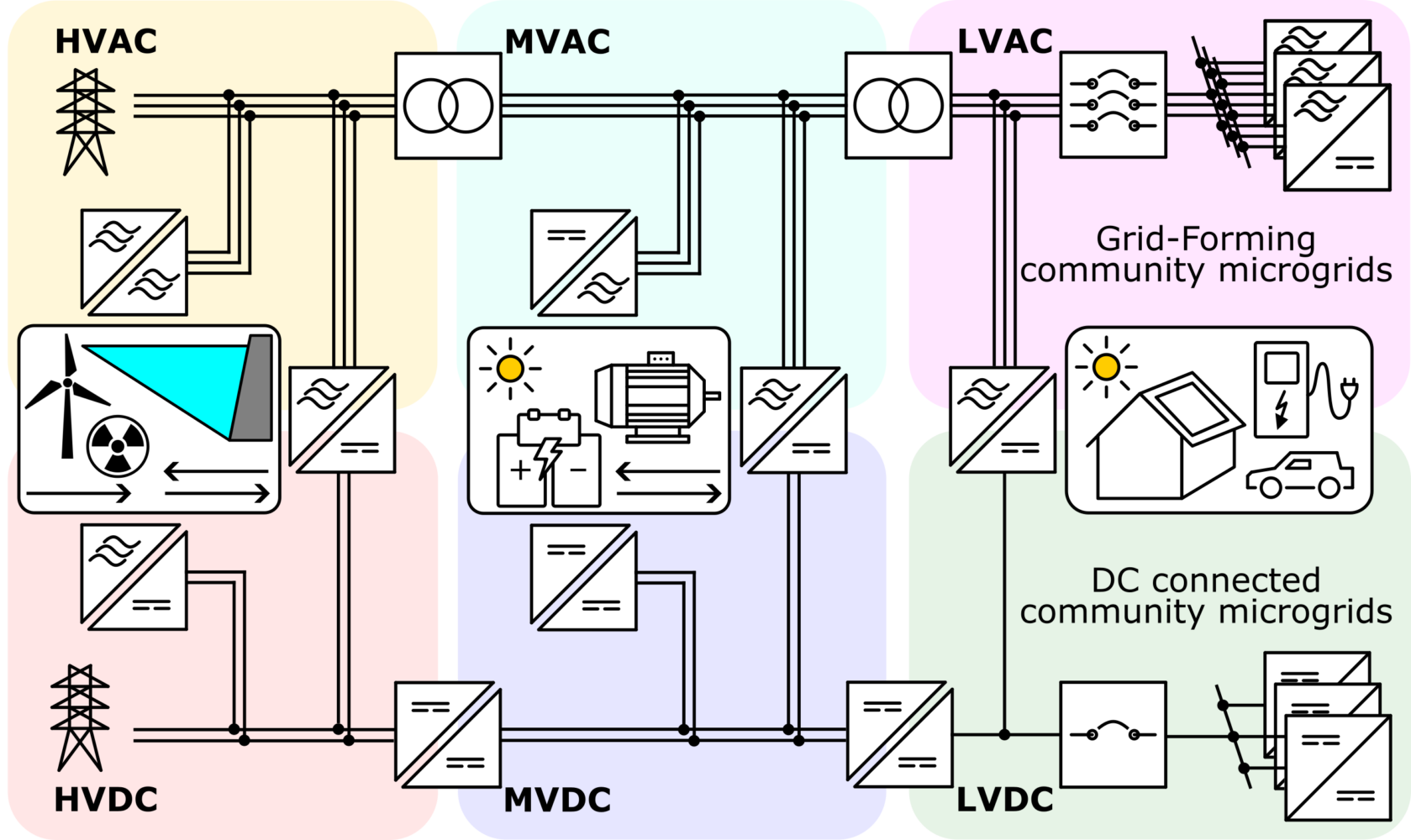

If you’ve been following my work, you know I’ve been writing about Solid State Transformers (SSTs) for years. In my article on DC microgrids, I described how “solid-state transformers (SSTs) are composed of modular, multi-stage elements that can be disconnected in the event of a fault” and praised their ability to “control or limit short-circuit currents.” I’ve been advocating the benefits of this technology for twenty years. I’ve used the term in papers, presentations, tutorials, and countless discussions with colleagues and students.
I was wrong. Or rather, I was using the wrong word.
A Stone thrown into the pond
At the recent Cigré Paris Session, I had the opportunity to work with colleagues on Study Committee B4 (DC Systems and Power Electronics). During the discussions, representatives of IEC TR 22F threw what one might call a stone into the pond. Their message was disarmingly simple, and its words are still resonating:
The voltage transformation is a capability of the power converters, not a property, as it is in a transformer.
In an electromagnetic transformer, voltage transformation is an inherent physical property, a direct consequence of Faraday’s law applied to the turns ratio of the windings. The transformer transforms because it cannot do otherwise. A power converter, on the other hand, can transform voltage among many other things it can do. It can also regulate power flow, provide reactive support, change frequency, isolate faults, and operate bidirectionally. Voltage transformation is one of its capabilities, not its defining property.
Why the term “Solid State Transformer” Is wrong
The argument from IEC TR 22F rests on a fundamental physical observation. A transformer, in the electromagnetic sense, operates on a principle of magnetic induction between coupled windings. Its behavior is governed by immutable physical laws: the turns ratio determines the voltage ratio, the core material sets the flux limits, and the frequency ties everything together. You don’t control a transformer; you design it, and then it does what physics dictates.
A power electronics converter does something fundamentally different. It uses semiconductor switches to actively shape the electrical waveform. Voltage transformation is achieved through modulation strategy, duty cycle, phase shift, backed with software-controllable parameters. The “transformation” is not a property of the device; it is a function that the device performs, one function among many.
Calling it a “transformer” implies that voltage transformation is intrinsic and fixed. It is neither. And what about the “DC transformer”? That phrase describes something that is physically impossible there is no passive magnetic device that transforms DC voltage through induction. The very concept is an oxymoron.
As for “Power Electronics Transformer” (PET), the same objection applies: it frames the device as a transformer implemented with power electronics, when in reality it is a power converter that happens to be able to perform voltage transformation among other functions.
The Correct Terminology
The IEC TR 22F position is that the appropriate term should be Electronic Power Converter (EPC), or more specifically, an EPC with isolation when galvanic isolation is provided. The term Electronic Power Transformer is also under consideration, though this remains in discussion and has not been finally confirmed.
For the DC case specifically the most precise description I would suggest would be isolated DC Electronic Power Converter. It’s not as catchy and selling as SST. It won’t fit as neatly in a conference title or a marketing strategy. But it is scientifically correct, and that should matter to us academics and engineers.
Why This Is Not Just Semantics
One might be tempted to dismiss this as a naming dispute but the implications extend well beyond language.
Standards and Testing
You do not test an electromagnetic transformer the way you test an electronic power converter. A transformer is subjected to dielectric tests, short-circuit impedance measurements, no-load and load loss tests, and thermal cycling based on the assumption of passive, continuous operation under sinusoidal excitation. An electronic power converter requires entirely different qualification procedures: switching reliability under thermal stress, control loop stability verification, EMC compliance for high-frequency switching harmonics, firmware validation, and fault response characterization.
If a device is called a “transformer,” there is a natural regulatory reflex to test it like one. This is not a hypothetical concern — standards committees and certification bodies navigate these classifications daily, and misclassification can lead to inadequate testing or, conversely, inappropriate requirements that stifle innovation.
Patents and Intellectual Property
What is a patent on a “Solid State Transformer” worth if the term itself is scientifically and terminologically incorrect? Patent claims built on imprecise terminology are vulnerable. If the patented invention is described using a term that the relevant technical committee has formally rejected as inaccurate, the scope and validity of that patent may be called into question. It is a genuine concern that intellectual property professionals in our field should be taking seriously.
Data Center DC Powering
Perhaps the most visible arera where this terminology matters is the ongoing transformation of data center power architectures. The SST has been positioned in literature, white papers, and social media as the number-one enabler for modern DC powering strategies in data centers. Vendor marketing materials routinely invoke the Solid State Transformer as a revolutionary replacement for the conventional low-frequency transformer.
The technology these materials refer to is real and genuinely transformative. It enables flexible control of power transfer between two grids, with bidirectional capability. In the AC case, it provides independent reactive power control, something no passive transformer can offer. In the DC case, it offers flexible voltage transformation, adaptable to varying bus voltages and load conditions. Galvanic isolation is achieved through medium-frequency transformer stages, dramatically reducing size and weight compared to line-frequency equivalents. Also, fault current limitation and selective disconnection of modular stages round out a capability set that no passive transformer could ever match.
None of these features is a transformation in the passive, electromagnetic sense. They are active control functions performed by a power converter. Calling the device a transformer obscures what makes it valuable and invites comparison with a component whose operating principles are entirely different.
Confession and Course Correction
I’ll be honest: changing the habit is not easy. “Solid State Transformer” is a term I’ve used for two decades. It’s in my publications, my lecture slides, my tutorials. The acronym “SST” rolls off the tongue and fits neatly in a subtitle. “Isolated DC Electronic Power Converter” is not so comfortable to spell. Many respected colleagues, institutions, and publications have used this terminology in good faith. The term has appeared in IEEE papers, Cigré brochures, IEC documents, and countless conference proceedings
But it is never too late to correct a mistake, especially one that carries consequences for scientific clarity, standards development, and legal precision. Language shapes how we think, and when our language is imprecise, our communication follows. If we cannot name our devices correctly, how can we expect to specify, test, certify, and protect them correctly?
So the next time I’ll be about to write “Solid State Transformer” in a paper, a proposal, or a patent application, I will ask myselkf: am I describing a device whose defining property is voltage transformation? Or am I describing a power converter that, among its many capabilities, can transform voltage?
link to International Electrotechnic Commission https://www.iec.ch/dyn/www/f?p=103:7:::::FSP_ORG_ID:1415