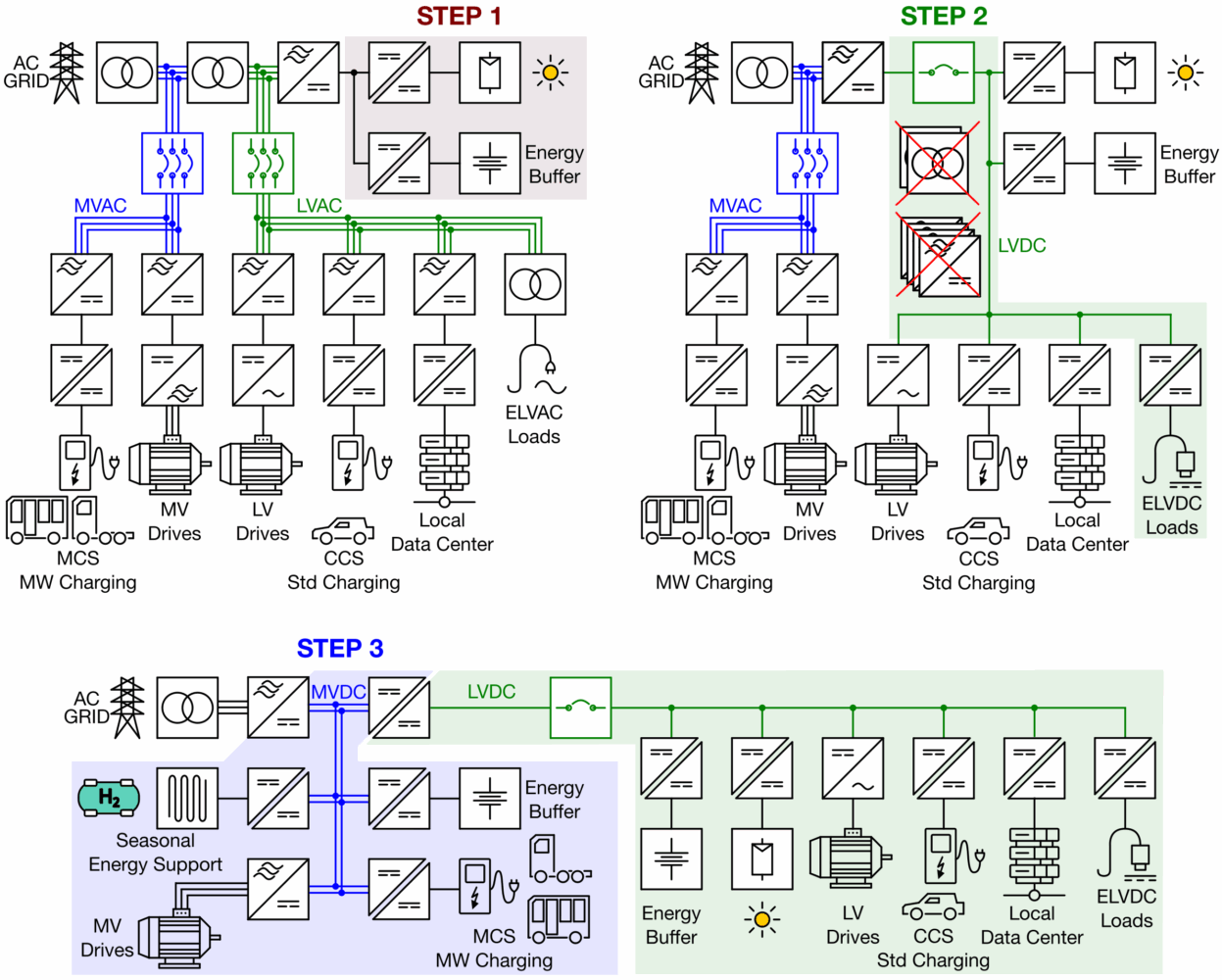
Decarbonizing our energy systems hinges on one fundamental principle: electrification. In order to shift away from fossil fuels, renewables are the cornerstone of this transition, with nuclear serving as a valuable bridge during the transformation. But simply generating clean energy isn’t enough; we need intelligent, flexible distribution networks capable of managing variable sources and diverse loads. This is where power electronics emerges as one of the critical enabling technologies for modern grids—without it, truly distributed and flexible energy systems remain out of reach.
High Voltage: The Foundation
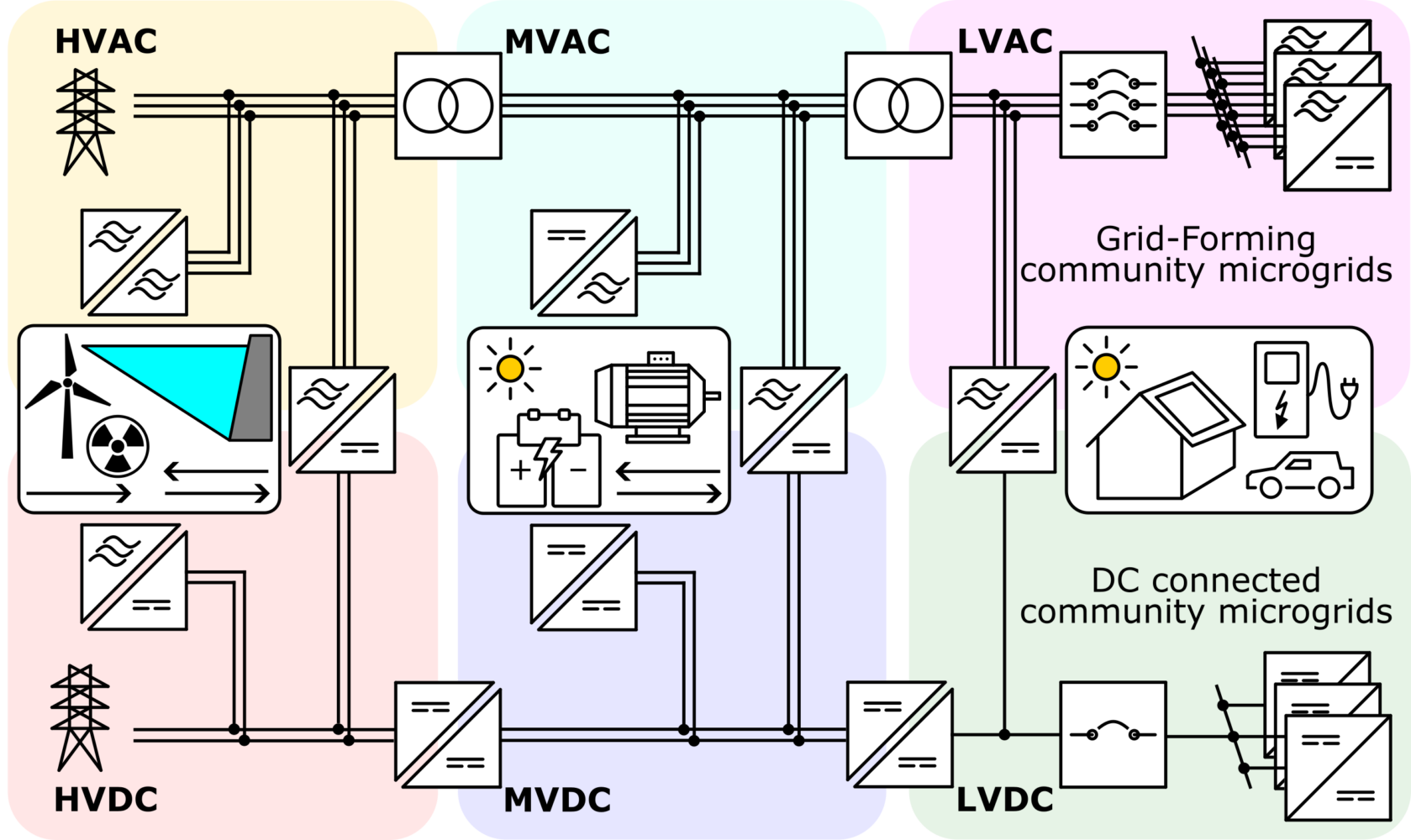
At the highest level, HVDC (High Voltage Direct Current) is far from a new concept—it predates the renewable revolution by decades, built upon mature rectifier and inverter technologies. Today, the bulk energy supply still comes from established sources: nuclear baseload, wind farms, and hydroelectric generation. Flexibility is primarily provided through pumped storage facilities and hydro plants with high dynamic response capabilities. The challenge now is integrating increasing volumes of distributed renewables while maintaining grid stability—a problem that increasingly favors DC architectures at transmission scale.
Medium Voltage: Where Renewables Multiply
The medium voltage (MVAC) domain is witnessing dramatic change. Utility-scale solar plants are proliferating, each requiring sophisticated power inverters capable of maximum power point tracking (MPPT) to extract optimal energy throughout varying conditions. Seasonal energy storage is being deployed, with vanadium redox flow batteries showing particular promise for multi-day duration applications.
Grid inertia—traditionally provided by spinning generators—must be artificially created through alternative means. Flywheel energy storage, synchronous condensers, or synthetic inertia from power reserves in renewable sources can fulfill this role. But there’s another evolution underway: MVDC collection grids. A compelling example is the OPHELIA project in southern France, which demonstrates a ±5 kV (up to ±10 kV nominal) MVDC network gathering power from a 1 MWp linear PV array. The demonstrator employs MVDC cables, DC circuit breakers, fuses, and high-power DC transformers capable of handling up to 800 kW—all proving the technological maturity needed for multi-megawatt-scale DC collector networks.
Hydrogen production presents an interesting case. Electrolysers are fundamentally DC devices. Research indicates that when supplied with well-regulated DC voltage, PEM (Proton Exchange Membrane) electrolysers achieve 70–80% efficiency (based on lower heating value), while alkaline units reach 65–75%. Supplying the same equipment from an AC source necessitates power electronics conversion stages—typically diode/thyristor bridges followed by active choppers—that introduce 2–5% additional losses through voltage drops and switching. An AC-fed system typically achieves 65–75% net efficiency (HHV), whereas direct DC supply maintains the intrinsic electrochemical efficiency. For hydrogen to play its anticipated role in seasonal storage and heavy industry, DC coupling offers a measurable efficiency advantage.
Low Voltage: Community-Scale Intelligence
At the distribution level, LVAC grid-forming community microgrids are becoming reality. These systems operate autonomously in islanded mode, drawing energy from local PV installations and EV batteries to serve neighborhood demand. Local production minimizes stress on existing distribution infrastructure, which would otherwise struggle to accommodate bidirectional power flows from widespread rooftop generation. Power electronics enables this entire paradigm—inverters with grid-forming capabilities that establish voltage and frequency references without central coordination.
The LVDC equivalent is emerging alongside EV charging infrastructure and data center deployments. These systems mirror the AC microgrid capabilities: islanding operation, black-start functionality, and transient support during disturbances. What makes them particularly attractive is the elimination of conversion stages for inherently DC loads and sources—EVs, batteries, solar panels, and IT equipment all speak DC natively.
Conclusion
As we navigate toward a hybrid AC/DC future spanning multiple voltage levels, one truth becomes unmistakably clear. Professor Dražen Dujić of EPFL succinctly captured it during a SCCER-Furies conference in 2017: “There is no smart grid without power electronics.” This isn’t merely an observation about component importance—it’s recognition that intelligence, flexibility, and controllability are inseparable from semiconductor-based power conversion.
Professor Rik De Doncker of RWTH Aachen offered an equally striking perspective regarding the physical constraints we face: “There is not enough copper on this planet for keeping on cabling in AC; DC is the only way for an electrified and decarbonized society.” His argument touches on thermal limits, reactive power losses, and the sheer material economy of conductor cross-sections required for equivalent power transfer.
Whether these prophetic statements come true depends entirely on the continued maturation of power electronic systems—their efficiency, reliability, and cost-effectiveness. As we build hybrid AC/DC grids from HV transmission down to LV community microgrids, power electronics won’t just enable the transition; it will define it.
Reference: OPHELIA: unlocking the full potential of linear photovoltaic power plants https://www.supergrid-institute.com/2025/12/08/ophelia-unlocking-linear-photovoltaic-power-plants/